What Is Digital Product Development: A Startup Guide
What Is Digital Product Development: A Startup Guide

Digital product development is defined as the end-to-end process of designing, building, and continuously improving software products that real users adopt and return to. It covers SaaS platforms, mobile apps, marketplaces, and internal enterprise tools. Unlike traditional software delivery, it treats the product as a living entity shaped by user behavior, not a finished artifact handed off at launch. For startup founders and entrepreneurs, understanding this process is the difference between shipping something people use and shipping something that sits unused.
What is the digital product development process?
The digital product development process follows the Product Development Life Cycle, known as the PDLC. The PDLC covers seven stages: strategy, validation, design, development, testing, release, and post-launch optimization. This is broader than the Software Development Life Cycle (SDLC), which focuses only on the engineering phases. The PDLC wraps business goals, user needs, and market demand around the technical work.
Each stage builds on the last, and skipping one creates problems downstream. A strong development process aligns business goals, user needs, technical feasibility, and market demand before a single line of code is written. Teams that skip validation and jump straight to development routinely build features nobody wants.
The seven stages work like this:
- Strategy — Define the problem, the audience, and the business case.
- Validation — Test assumptions with real users before committing to a build.
- Design — Create wireframes, prototypes, and user flows based on validated insights.
- Development — Build the product in short, testable increments.
- Testing — Run quality assurance (QA) throughout, not just at the end.
- Release — Ship to users with a clear launch plan.
- Post-launch optimization — Measure adoption, gather feedback, and iterate.
Pro Tip: Treat validation as a money-saving step, not a delay. Testing a prototype with five users before development begins costs a fraction of rebuilding a feature after launch.
Modern teams ship updates every two weeks and conduct user tests in each sprint. That cadence keeps the product aligned with real user behavior rather than internal assumptions.
How does digital product development differ from traditional software development?
Traditional software development starts with a fixed set of requirements and measures success by delivering those requirements on time and on budget. Digital product development starts with a user problem and measures success by whether people actually use the product. That is a fundamental shift in mindset, not just process.
The table below shows the core differences:
| Dimension | Traditional software development | Digital product development |
|---|---|---|
| Success metric | Feature delivery and deadline | User adoption and retention |
| Process shape | Linear, fixed scope | Iterative, continuous cycle |
| User involvement | Requirements phase only | Every sprint |
| Product status at launch | Finished | Starting point |
| Risk management | Front-loaded planning | Continuous validation |
Software that ships but sits unused is considered a failure in digital product development. That standard forces teams to stay connected to user behavior throughout the entire lifecycle, not just at handoff.
The practical implications for founders are significant:
- You cannot define all requirements upfront and expect them to hold.
- Speed alone is not the goal. Decision order matters more than delivery pace.
- Every release is a learning opportunity, not a finish line.
- Post-launch work is built into the plan, not treated as maintenance.
Digital product development is a continuous cycle without a fixed end. Post-launch optimization is integral to the process, not an optional extra added when something breaks.
What are the key components of digital product development?
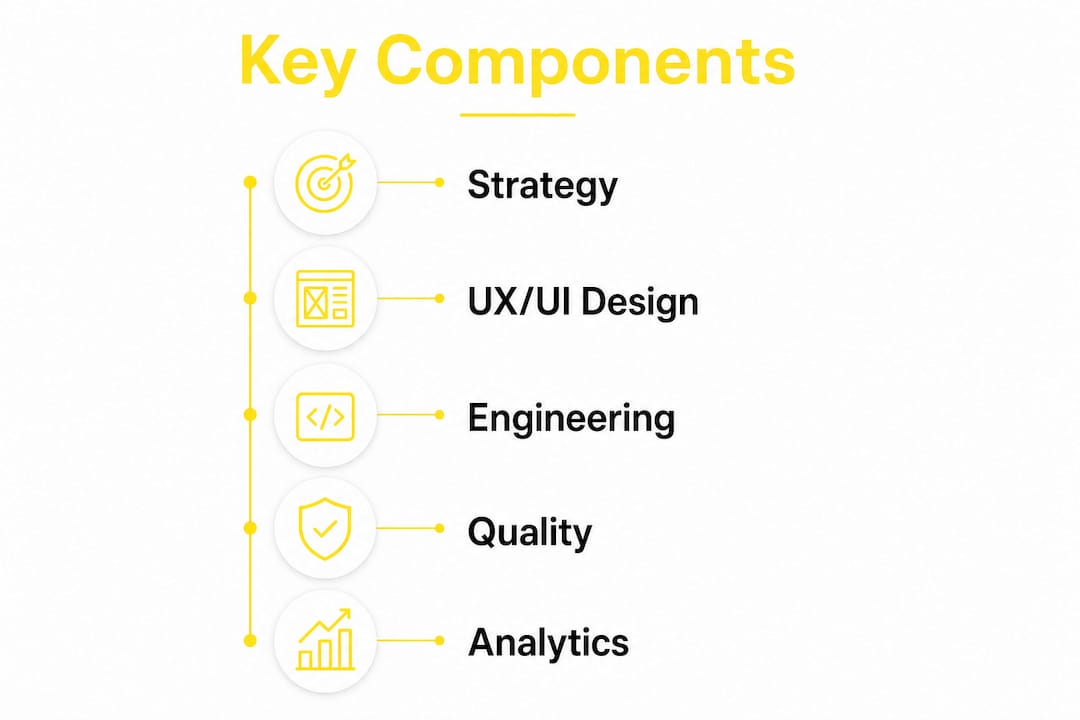
Five disciplines make up a complete digital product development function. Each one is necessary. Gaps in any single area create compounding problems across the others.
Strategy and discovery is where the work begins. Teams research user problems, map the competitive context, and define what success looks like before any design or engineering starts. Without this, teams build confidently in the wrong direction.
UX/UI design translates validated insights into interfaces users can navigate without friction. The digital product design process covers user flows, wireframes, interactive prototypes, and usability testing. Good design reduces support costs, improves retention, and increases conversion. It is not decoration.

Engineering builds the product in iterative increments. Agile development practices break work into two-week sprints, each producing a testable, shippable increment. The engineering team is also responsible for architecture decisions that affect performance, security, and the cost of future changes.
Quality assurance runs throughout the cycle, not just before launch. Integrated QA catches problems when they are cheap to fix. Teams that push QA to the end of a project routinely face expensive rework and delayed releases.
Analytics and feedback loops close the cycle. Adoption metrics, session recordings, support tickets, and user interviews all feed back into the next iteration. Involving users early and continuously improves validation and reduces the risk of building unwanted features.
Pro Tip: Set up analytics before launch, not after. Knowing your baseline retention rate from day one gives you a benchmark to measure every subsequent change against.
What are the benefits and challenges of digital product development for startups?
The benefits of adopting a proper digital product development process are concrete and measurable.
- Faster market validation. Short sprints and regular user testing surface problems before they become expensive. You learn what works in weeks, not quarters.
- Reduced build risk. Validation before development means you commit resources to ideas that have already shown user demand.
- Better product-market fit. Continuous feedback keeps the product aligned with how users actually behave, not how you assumed they would.
- Adaptability. When market conditions shift, an iterative team can redirect in the next sprint. A team locked into a fixed-scope project cannot.
The challenges are equally real, and founders who ignore them pay for it.
Many project failures arise from improperly executed Product Development Life Cycles that misalign strategy, validation, and delivery rather than from purely technical problems. The root cause is almost always a process failure, not a code failure.
The most common mistakes founders make:
- Treating the development process as a linear project with a defined end date.
- Prioritizing speed over decision order, which produces waste at scale.
- Skipping the validation stage to save time, then rebuilding after launch.
- Measuring success by features shipped rather than by user adoption and retention.
Decision sequencing and iteration matter more than raw speed. Making the right decisions in the right order prevents wasted engineering time on features that do not move the needle. Startups that work with experienced product design consultants often compress this learning curve significantly by bringing in process discipline from the start.
Key Takeaways
Digital product development succeeds when teams prioritize decision order, continuous user validation, and adoption metrics over feature count or delivery speed.
| Point | Details |
|---|---|
| PDLC over SDLC | The Product Development Life Cycle wraps business goals and user needs around the engineering process. |
| Adoption defines success | Software that ships but sits unused is a failure, regardless of code quality or delivery timeline. |
| Validation before build | Testing assumptions with users before development begins reduces wasted resources and rework. |
| Continuous iteration | Post-launch optimization is built into the process, not treated as optional maintenance. |
| Decision order matters | Making the right decisions in sequence prevents waste more effectively than increasing delivery speed. |
Why most founders get digital product development wrong
The most persistent mistake I see is founders treating digital product development as a project with a finish line. They plan a launch date, ship the product, and then wonder why adoption is flat. The launch is not the end. It is the first real data point.
The second mistake is confusing speed with progress. Moving fast through the wrong decisions produces a polished product that nobody uses. The teams I have seen build well are not necessarily the fastest. They are the most disciplined about sequencing. They validate before they design. They design before they build. They measure before they iterate. That order is not bureaucracy. It is how you avoid spending £50,000 on a feature set that misses the market entirely.
The third thing most articles will not tell you is that success is measured by user adoption, not by project completion. Founders who internalize that shift stop asking “when will it be done?” and start asking “what do users do after they sign up?” That question changes every decision that follows. If you want to build a product that compounds in value over time, treat the development process as a repeatable discipline, not a one-time sprint to launch.
— William
How Wallandfifth helps founders build products that work
Wallandfifth works with founders and businesses that need more than a developer. The work covers product strategy, UX/UI design, app builds, and launch execution, all under one roof.
If you are at the idea stage or sitting on a product that is not performing, Wallandfifth brings the process discipline and design thinking that turns concepts into products people actually use. Recent work includes a full app build for LOOPA, covering brand direction, wireframes, product logic, APIs, and App Store submission. For founders who want to build right the first time, MVP product design is the fastest path from validated idea to launch-ready product.
FAQ
What is digital product development in simple terms?
Digital product development is the process of designing, building, and improving software products that real users adopt. It covers the full lifecycle from strategy and validation through to post-launch iteration.
How does the PDLC differ from the SDLC?
The PDLC (Product Development Life Cycle) is broader than the SDLC (Software Development Life Cycle). The PDLC includes strategy, validation, and post-launch optimization stages that sit outside the engineering process.
How long does digital product development take?
Timeline depends on product complexity, but modern teams ship working increments every two weeks. A validated MVP typically takes 8–16 weeks from discovery to launch.
What does success look like in digital product development?
Success is measured by user adoption and retention, not by features delivered or deadlines met. A product that ships but sits unused is a failure regardless of its technical quality.
When should a startup hire a product design agency?
A startup benefits most from external product design support at the validation and design stages, before significant engineering investment is made. Early involvement reduces the risk of building the wrong product.
Recommended
- MVP Digital Product — Build Your First Digital Product | Wall & Fifth | Wall & Fifth
- Product Design for Startups — Commercial Thinking, Not Just Craft | Wall & Fifth
- Product Development for Startups — From Idea to Launched Product | Wall & Fifth | Wall & Fifth
- Digital Growth Strategy for Startups — Beyond Launch, Into Scale | Wall & Fifth