API Integration Cost: A Startup Founder's 2026 Guide
API Integration Cost: A Startup Founder’s 2026 Guide

API integration cost is defined as the total expense of connecting software systems via APIs, covering initial development, ongoing maintenance, and operational usage fees. For startup founders and business owners, this number is rarely what it first appears. A project quoted at $15,000 can quietly grow to $40,000 or more over two years once maintenance, monitoring, and API call charges are factored in. This guide breaks down every cost component, from first build to recurring charges, so you can budget with accuracy and avoid the surprises that derail early-stage products.
What factors influence API integration cost?
The final price of any integration depends on several variables that compound quickly. Understanding them before you scope a project is the difference between an accurate budget and a costly revision.
- Number of systems connected. Each additional system adds complexity. Connecting a payment gateway to a CRM is straightforward. Adding a logistics API, a data warehouse, and a third-party auth provider multiplies the work.
- Custom build vs. iPaaS. A custom integration gives you full control but requires engineering time. An iPaaS platform (integration-as-a-service) like Zapier or Make trades flexibility for speed and lower upfront cost.
- Data complexity and real-time sync. Simple one-way data pushes are cheap. Bidirectional, real-time syncing with conflict resolution and error handling adds significant engineering hours.
- Security and compliance requirements. Security and compliance overhead can increase base costs by 20–50%. Enterprise-grade auth, encryption, and audit logging are not optional for regulated industries.
- Legacy system challenges. Older systems often lack modern API support. Bridging them requires custom middleware or adapters, which adds both time and cost.
- API call frequency. Usage-based pricing charges by the number and complexity of API calls. High call frequency without optimization leads to unexpected billing spikes.
The most expensive integrations are not always the most complex technically. A simple integration with a poorly documented third-party API can cost more than a well-scoped custom build, because the learning curve alone extends timelines.
Pro Tip: Before scoping any integration, request the API documentation from every third-party vendor. Poor documentation is a reliable signal that build time will run long.

How to estimate and budget for initial API integration costs
The upfront cost of an API integration project depends heavily on scope and approach. The table below gives realistic ranges for 2026 based on US and UK market data.
| Project type | Typical cost range | What it covers |
|---|---|---|
| Simple iPaaS setup | $500–$3,000 setup + $20–$200/month | 1–2 systems, low data complexity, no custom logic |
| Small custom integration | $5,000–$15,000 | Single API, moderate complexity, basic error handling |
| Medium custom integration | $15,000–$30,000 | Multiple APIs, real-time sync, auth, testing |
| Complex or enterprise build | $30,000–$50,000+ | Many systems, compliance, legacy support, full QA |
iPaaS setups like Zapier or Make typically cost $500–$3,000 in setup fees plus $20–$200 per month in subscriptions. They work well for connecting one or two systems with standard data flows. Custom integrations for SMBs typically run $10,000–$50,000 for the initial build when native connectors are not available.
The initial build cost is only part of the picture. Initial build costs represent just 30–40% of total ownership cost over two years. The remaining 60–70% sits in learning, monitoring, and maintenance. That ratio surprises most founders who budget only for development.
A full cost breakdown for a medium-complexity project looks like this:
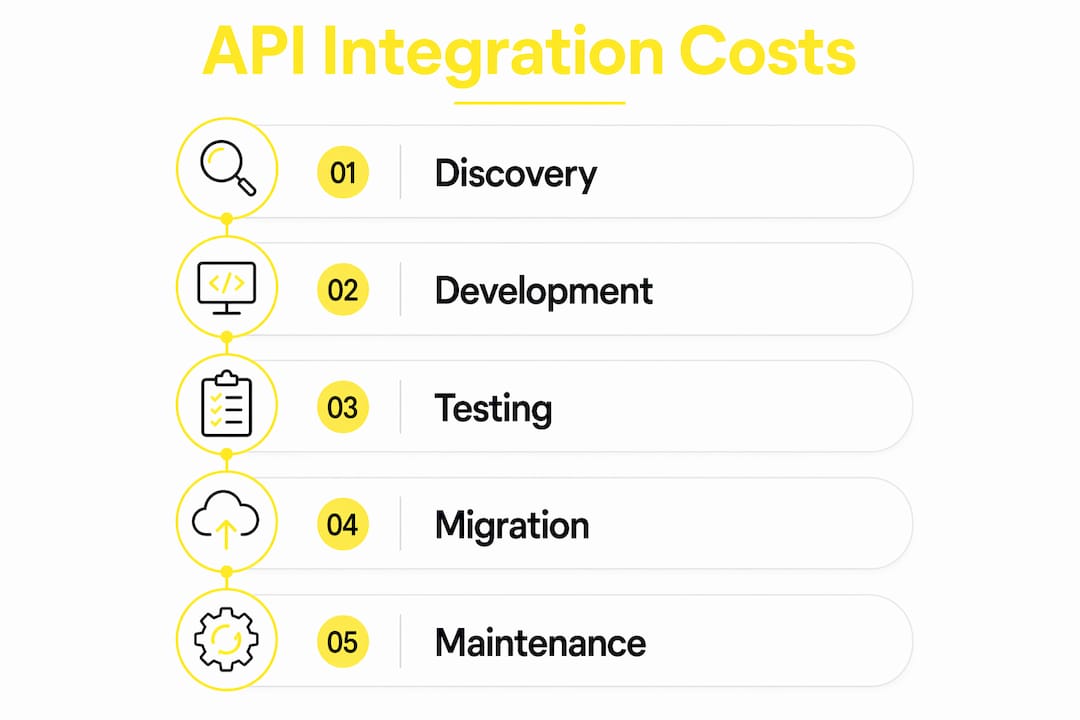
- Discovery and scoping: $1,000–$3,000
- Development and testing: $10,000–$20,000
- Data migration and cleanup: $1,500–$5,000
- Documentation: $500–$2,000
- Initial monitoring setup: $500–$1,500
Hidden costs in discovery, documentation, and data migration often account for more time and budget than the actual development work, especially on first-time projects. Founders who skip the discovery phase typically pay for it twice: once in rework and once in delayed launches.
Pro Tip: Always include a 15–20% contingency on your integration budget. Scope changes mid-build are common, and having a buffer prevents the project from stalling.
What are the ongoing API integration costs?
The recurring costs of an API integration are where most founders get caught off guard. These expenses do not end at launch. They grow as your product scales.
Annual maintenance and support typically runs 15–25% of the initial build cost each year. For a $20,000 integration, that is $3,000–$5,000 per year. Over five years, that accumulates to $15,000–$20,000 in maintenance alone, before accounting for usage fees.
Maintenance covers more than bug fixes. It includes:
- API version updates. Third-party APIs release new versions and deprecate old ones. Missing an update can break your product overnight.
- Authentication changes. OAuth tokens, API keys, and security protocols change. Handling auth updates requires ongoing engineering attention.
- Breaking changes from vendors. Third-party services modify their data structures without warning. Your integration needs monitoring to catch these before users do.
- Performance monitoring. Tracking response times, error rates, and uptime is a continuous task, not a one-time setup.
API usage fees add another layer of recurring cost. Many platforms charge based on the number and complexity of API calls, and these fees scale with your traffic. A product with 1,000 users behaves very differently from one with 100,000 users. As call volume grows, so does the monthly bill. Founders who do not model this growth in their financial projections often face a pricing crisis at the exact moment their product gains traction.
The risk of API usage fees becoming significant operational expenses grows as traffic increases. Budget for at least three traffic scenarios: current, 5x growth, and 20x growth. Know what each scenario costs before you commit to a vendor’s pricing tier.
What are the hidden costs in API integration projects?
The most common misconception about API integration pricing is that cost equals coding hours. It does not. Integration cost is often misunderstood as just a coding expense, but a large portion of the budget goes to broader implementation work that never touches a line of code.
Hidden costs that regularly catch founders off guard include:
- Training and onboarding. Your team needs to understand how the integration works, what to monitor, and how to respond to failures.
- Documentation. Poor documentation creates support debt. Every hour spent writing clear docs saves hours of future troubleshooting.
- Data cleanup. Migrating dirty data between systems requires manual review, transformation scripts, and validation. This is almost always underestimated.
- Vendor pricing traps. API call spikes during peak periods can trigger overage charges. Some vendors apply peak-time surcharges that are buried in their terms.
- In-house learning curves. The initial learning curve when integrating with a new system can extend build time by 1.5–3 times. Specialist teams reduce this cost by using experience and reusable code.
- Opportunity cost. An in-house team learning a new API is not building your core product. That lost time has a real financial value.
The honest truth is that a first-time integration always costs more than a repeat integration. Experienced teams bring reusable patterns, known pitfalls, and faster debugging. That experience gap is worth paying for.
How can startup founders manage API integration costs?
Cost control in API integration starts before a single line of code is written. The decisions made during scoping and vendor selection determine 80% of the final bill.
-
Choose the right integration approach. Use iPaaS for simple, standard connections. Use custom builds only when your data flows, business logic, or compliance requirements exceed what an iPaaS platform supports. Matching the tool to the complexity saves money immediately.
-
Plan for maintenance from day one. Add 15–25% of your build cost to your annual budget for maintenance. Do not treat it as optional. An unmaintained integration is a liability, not an asset.
-
Optimize API call frequency. Batch requests where possible. Use caching to avoid redundant calls. Architectural strategies like caching and batching can substantially reduce monthly usage fees. This is an engineering decision with a direct financial impact.
-
Understand vendor pricing tiers before you commit. Read the pricing page carefully. Know what triggers an overage. Model your expected call volume against each tier before signing up.
-
Monitor usage continuously. Set up alerts for call volume thresholds, error rates, and response time degradation. Catching a billing spike early costs far less than discovering it on an invoice.
-
Engage experienced integrators. Specialist teams reduce the learning curve that inflates first-time build costs. For startup app development, the cost of experience is almost always lower than the cost of inexperience.
The founders who manage integration costs well treat the integration as a product decision, not a technical afterthought. They scope it carefully, budget for its full lifecycle, and monitor it like any other operational expense.
Key Takeaways
API integration cost is a lifecycle expense, not a one-time fee. Founders who budget only for the initial build consistently underestimate total ownership cost by 60–70%.
| Point | Details |
|---|---|
| Total cost of ownership | Initial build is only 30–40% of two-year costs; maintenance and usage fees make up the rest. |
| Ongoing maintenance budget | Set aside 15–25% of your build cost annually for maintenance, updates, and monitoring. |
| iPaaS vs. custom build | iPaaS suits simple setups at $500–$3,000 upfront; custom builds run $10,000–$50,000 for SMBs. |
| Hidden costs are real | Discovery, data migration, documentation, and training regularly exceed development costs on first-time projects. |
| Usage fees scale with traffic | API call pricing grows with your user base; model three traffic scenarios before committing to a vendor tier. |
What I’ve learned about API integration budgets for startups
The projects that go over budget almost always share one trait: the founder treated integration as a line item, not a system. They got a quote for the build, approved it, and assumed the work was done when the code shipped.
What I see repeatedly is that the real cost pressure arrives six months after launch. A third-party API releases a breaking change. Call volume doubles. A compliance requirement surfaces that nobody scoped. Each of these events costs money, and none of them are unusual. They are the normal operating conditions of a live integration.
The founders who handle this well are the ones who budgeted for it. They included a maintenance contract in their initial plan. They modeled usage fees at scale. They chose a team with experience in the specific APIs they needed, which cut the learning curve and the bill.
My honest advice: treat your integration budget the same way you treat your MVP product design budget. Scope it properly, include the full lifecycle, and do not cut corners on discovery. A well-scoped integration is an asset. A poorly scoped one is a recurring problem that costs more to fix than it would have cost to do right the first time.
— William
How Wallandfifth approaches API integration in product builds
Wallandfifth builds digital products for founders who need more than a developer. API integration is part of almost every product we ship, from payment gateways to third-party data feeds to auth layers.

When we scope a product build, we include integration planning from the start. That means mapping every API dependency, modeling usage costs at scale, and building with maintenance in mind. Founders who work with us get a clear picture of their total app development cost before a line of code is written, including integration charges, not just development hours. If you are planning a product that involves API connections, our startup product design service is the right starting point.
FAQ
How much does API integration cost for a startup?
API integration costs for startups typically range from $5,000 for a simple custom build to $50,000 or more for complex, multi-system integrations. iPaaS setups start lower, at $500–$3,000 upfront plus monthly fees.
What is included in API integration pricing?
API integration pricing covers discovery, development, testing, data migration, documentation, and ongoing maintenance. Usage-based API call fees are a separate recurring cost that scales with traffic volume.
Why is the average cost of API integration higher than the initial quote?
The initial build represents only 30–40% of total two-year ownership cost. Maintenance, monitoring, version updates, and API usage fees account for the remaining 60–70%, which most initial quotes do not include.
How do I budget for ongoing API integration expenses?
Add 15–25% of your initial build cost to your annual budget for maintenance and support. Separately, model your expected API call volume at current, 5x, and 20x traffic levels to estimate usage fees at scale.
Can I reduce API integration costs without cutting quality?
Yes. Using caching and batching to reduce API call frequency lowers usage fees directly. Choosing iPaaS for simple connections avoids custom build costs. Hiring experienced integrators reduces the learning curve that inflates first-time project budgets.
Recommended
- App Development Cost — What Building an App Really Costs | Wall & Fifth | Wall & Fifth
- SaaS Development Cost — What Building a SaaS Product Really Costs | Wall & Fifth | Wall & Fifth
- Data Analytics Cost — What a Data & Dashboard Build Really Costs | Wall & Fifth | Wall & Fifth
- AI App Development Cost - What It Really Costs, Including Inference | Wall & Fifth | Wall & Fifth