How to Choose an App Design Company in 2026
How to Choose an App Design Company in 2026

An app design company is a specialist firm that creates the user experience, interface, and interactive flows that determine how people use your digital product. The industry term for this work is UX/UI design, covering everything from user research and wireframing to visual systems and prototype testing. For startup founders and business owners, choosing the right mobile app design company is one of the highest-leverage decisions in a product build. Get it right and you ship something users actually understand. Get it wrong and you spend months redesigning what should have worked the first time.
What does an app design company actually do?
An app design company delivers far more than screens that look good. The core work spans UX research, user journey mapping, wireframing, interactive prototyping, and a final UI system that developers can build from. Each of these stages serves a distinct purpose in reducing risk and improving the product before a single line of production code is written.
The services a strong design studio provides typically include:
- UX research and user journey mapping to identify where users get confused and drop off
- Wireframing and low-fidelity prototyping to test flows before committing to visual design
- High-fidelity UI design covering typography, color, spacing, and component libraries
- Cross-platform design systems that keep iOS, Android, and web interfaces consistent without duplicating effort
- Interaction design and micro-animations that signal state changes and guide user behavior
- Handoff documentation so developers build exactly what was designed
Cross-platform design using a single design system saves time and simplifies future updates across both iOS and Android. That matters because maintaining two diverging visual systems is one of the most common sources of technical debt in early-stage products.
Data-driven design decisions, using user behavior analytics and product metrics, improve usability and guide iterative improvements after launch. Integrating analytics thinking at the design stage means you are not guessing what to fix in version two.

Pro Tip: Choose a design partner with direct engineering experience on their team. A studio that has shipped production software understands what is buildable, what will break, and how to write handoff documentation that developers actually use.
How to choose the best app design company for your startup
The best app design company for your startup is the one that understands your business goals, not just your screen count. Portfolio quality matters, but it is a starting point, not the whole picture. You need to evaluate how a firm thinks, how it communicates, and whether it can stay aligned with your product as it evolves.
Work through these criteria before signing anything:
- Industry and technology fit. Has the firm designed for your sector before? Do they understand your stack, whether that is React Native, Swift, or Flutter?
- Product strategy involvement. The best firms shape what gets built, not just how it looks. Look for evidence of product thinking in their case studies.
- Portfolio depth. Assess for usability and flow logic, not just visual polish. Ask whether the products they designed are still live and performing.
- Engagement model. Project-based fixed quotes suit defined scopes. Monthly retainers work for ongoing iteration. Subscription design plans offer predictable costs for startups that need continuous output without renegotiating scope each time.
- Communication and process. How often do they share work in progress? Do they use Figma with shared access? Do they document decisions?
The table below compares what to expect from different types of design providers:
| Criteria | Freelancer | Design agency | Integrated design and build team |
|---|---|---|---|
| Design system depth | Limited | Strong | Strong |
| Engineering alignment | Rare | Variable | Built in |
| Scalability | Low | Medium | High |
| Accountability | Individual | Team | Team |
| Handoff documentation | Inconsistent | Usually included | Always included |
| Cost | Lowest | Mid to high | Mid to high |
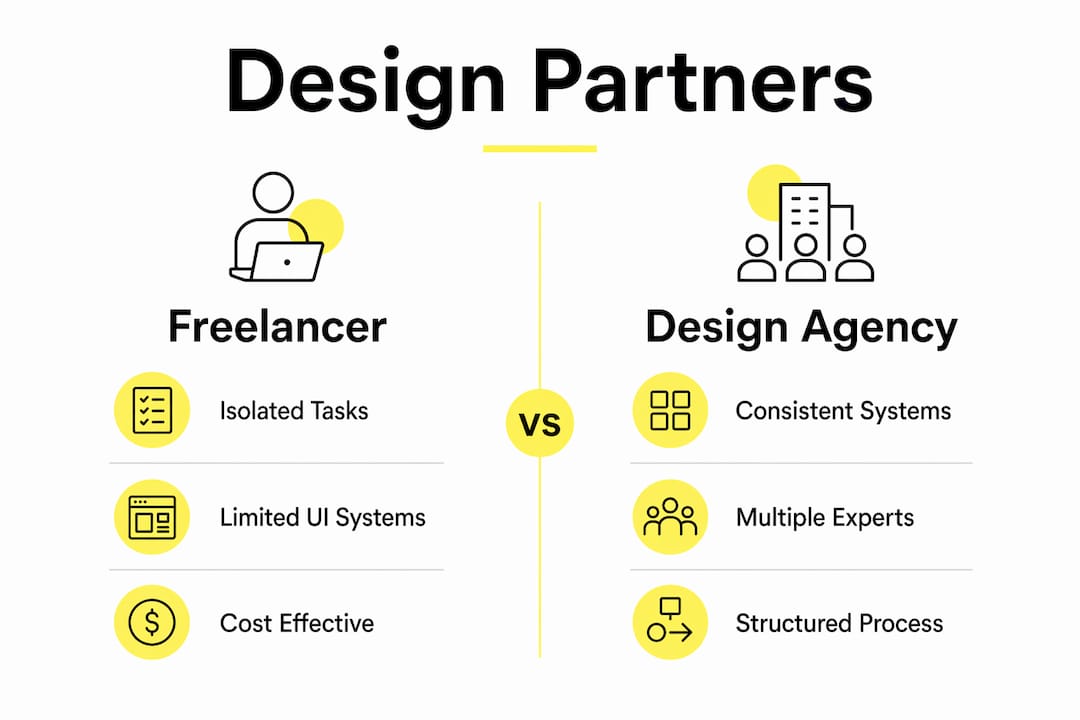
Freelancers suit isolated tasks but typically cannot deliver consistent UI systems across a growing product suite. Established agencies provide dedicated teams and detailed documentation that hold up as the product scales.
Pro Tip: Ask every shortlisted firm to walk you through a past project from brief to handoff. How they describe that process tells you more than any portfolio screenshot.
For a broader view on selecting digital product partners, choosing the right vendor follows many of the same principles regardless of whether the scope is design, development, or both.
What does app design company cost?
App design company cost varies significantly based on scope, complexity, and the type of firm you hire. Basic app designs typically run from $5,000 to $10,000. Advanced designs with deeper UX research, more screens, and a full component library range from $15,000 to $20,000 or more. Enterprise-grade products with multiple user roles and complex flows sit above that band.
Several factors push the price up or down:
- Number of screens and user roles. A two-role app with 20 screens costs far less than a marketplace with five user types and 80 screens.
- Research depth. Projects that include user interviews, usability testing, and analytics review cost more upfront but reduce rework later.
- Platform coverage. Designing for iOS, Android, and web simultaneously adds scope, even with a shared design system.
- Iteration cycles. Fixed-price quotes often cap revision rounds. Hourly and retainer models give more flexibility but require tighter scope management.
The pricing model you choose carries real consequences. Fixed quotes protect your budget but can limit iteration. Hourly rates give flexibility but require close oversight. Subscription plans offer the most predictable cost for ongoing work.
Underinvesting in UX upfront leads to higher user confusion, more support calls, and costly redesigns after launch. Spending adequately at the design stage is cheaper than fixing a broken product in production.
Pro Tip: When comparing quotes, check what is included in handoff. A quote that excludes developer-ready files, component specs, and interaction notes will cost you more in development time than the money you saved on design.
Common challenges in app design projects
The most damaging problems in app design projects are not visual. They are structural. The two biggest failure modes are unclear user flows and the handoff gap.
Most mobile apps fail because users feel confused about what to do next after opening the app. Clear user flows drive retention more reliably than visual aesthetics alone. A product that looks beautiful but leaves users uncertain where to tap will lose them within the first session.
The handoff gap is the second major risk. Design agencies that deliver static files without ensuring engineering alignment cause costly rework and delays. Developers interpret ambiguous designs differently. Spacing, states, edge cases, and error flows that were never specified get built incorrectly and then fixed expensively.
Other common challenges include:
- Inconsistent visual systems. Without a component library, designers and developers make independent decisions that fragment the interface over time.
- Scope creep in iteration. Without a defined process for reviewing and approving designs, projects expand and timelines slip.
- Analytics blind spots. Products designed without instrumentation in mind miss the data needed to improve after launch.
Eliminating the handoff gap requires either an integrated team where designers and engineers work side by side, or thorough documentation reviewed by the engineering lead before development starts. Both approaches work. The worst outcome is neither.
Staying current on UX design trends and mobile-first design principles also helps teams avoid building interfaces that feel dated before they launch.
Key Takeaways
Choosing the right app design and development company requires evaluating product strategy alignment, engineering integration, and realistic budget planning before visual quality.
| Point | Details |
|---|---|
| User flows beat visual polish | Clear navigation and task flows drive retention more than aesthetics alone. |
| Handoff quality determines build quality | Insist on developer-ready files, component specs, and interaction notes before development starts. |
| Budget realistically from the start | Basic designs start at $5,000; advanced work runs $15,000–$20,000 or more depending on scope. |
| Match the engagement model to your stage | Fixed quotes suit defined scopes; subscriptions suit startups that need continuous iteration. |
| Integrated teams reduce rework | Firms that combine design and engineering eliminate the handoff gap that derails most projects. |
What I’ve learned from watching startups pick the wrong design firm
The most common mistake I see founders make is hiring on aesthetics. They look at a portfolio, see screens that look polished, and sign the contract. Six months later they are back at the start because the product shipped with flows that confused users, a design system that developers could not implement consistently, and no documentation to show for it.
The second mistake is treating design as a one-time deliverable. The best UX/UI design work for startups is iterative. You design, ship, measure, and refine. A firm that hands over files and disappears is not a design partner. It is a vendor. Those are different things with very different outcomes.
What actually works is finding a firm that asks hard questions before opening Figma. What does success look like in six months? Who are the two or three users this product must work for? What does the business need users to do? Those questions shape every design decision that follows. Visual craft matters, but it should serve a commercial logic, not substitute for one.
The firms worth hiring are the ones that push back when a feature request does not serve the user or the business. That friction is a feature, not a problem.
— William
Wallandfifth builds apps that work, not just apps that look good
Wallandfifth is a product design and build agency for founders and businesses that need more than a developer. The work covers product strategy, UX/UI design, app builds, and launch execution under one roof. That means no handoff gap, no siloed teams, and no rework caused by designers and engineers working from different assumptions.
Recent work includes a full app build for LOOPA covering brand direction, wireframes, product logic, APIs, and App Store submission. For founders at the idea or early-build stage, the product design for startups service covers everything from initial strategy through to a launch-ready product. If you are weighing up your options, the app development cost guide breaks down what a real build actually costs.
FAQ
What does an app design company do?
An app design company handles UX research, user journey mapping, wireframing, UI design, and handoff documentation for mobile and web products. The goal is a product that users understand and return to.
How much does it cost to hire an app design company?
Basic app designs typically cost $5,000–$10,000. Advanced designs with deeper research and more screens run $15,000–$20,000 or more, depending on complexity and platform coverage.
What is the difference between a design agency and a freelancer?
Freelancers suit isolated tasks but rarely deliver consistent design systems across a growing product. Agencies provide dedicated teams, documentation, and accountability that scale with the product.
What is the handoff gap in app design?
The handoff gap occurs when a design firm delivers static files without ensuring engineering alignment. It causes developers to misinterpret designs, leading to rework, delays, and inconsistent builds.
How do I know if an app design company is the right fit?
Ask them to walk through a past project from brief to handoff. Evaluate whether they ask about business goals before opening design tools, and check whether their documentation is detailed enough for developers to build from without guessing.
Recommended
- How to Choose a Web App Development Company in 2026 | Wall & Fifth
- Blog — Digital Strategy for Founders & Operators | Wall & Fifth
- App Development for Founders — Custom Web & Mobile Apps, Owned by You | Wall & Fifth | Wall & Fifth
- Web App vs Mobile App - Which Should Your MVP Be? | Wall & Fifth | Wall & Fifth