App Development Services for Startup Founders: 2026 Guide
App Development Services for Startup Founders: 2026 Guide

App development services are professional, end-to-end solutions that take a digital idea from concept to a launched, functional mobile application. For startup founders, the stakes are high. The wrong technology choice, a missed maintenance budget, or a poor agency fit can cost months and thousands of dollars. This guide cuts through the noise on native versus cross-platform development, realistic timelines, what post-launch support actually costs, and how to pick a development partner who delivers. Whether you are building an MVP or a full production app, these decisions shape everything that follows.
What types of app development services are available?
App development services fall into three main categories: native development, cross-platform development, and Progressive Web Apps (PWAs). Each serves a different product need, budget, and timeline.
Native development uses Swift for iOS and Kotlin for Android. It delivers the best performance and the deepest integration with device hardware, including cameras, GPS, biometrics, and Bluetooth. The trade-off is cost and time. Native apps take longer to build, typically 16 weeks or more for both platforms, and require two separate codebases maintained in parallel.

Cross-platform development uses frameworks like React Native and Flutter to share a single codebase across iOS and Android. Flutter and React Native are the leading options, with Flutter preferred for UI-heavy apps and React Native for teams with JavaScript expertise. A cross-platform production app typically ships in 10–14 weeks. That time saving is significant when you are racing to validate a market.
Progressive Web Apps are browser-based applications that behave like mobile apps without requiring App Store distribution. They work well for content-heavy products or tools where offline functionality is limited. For most founders building a true mobile product, PWAs are a fallback, not a first choice.
| Type | Timeline | Cost level | Best for |
|---|---|---|---|
| Native iOS + Android | 16+ weeks | High | Hardware-intensive apps |
| Cross-platform (Flutter/React Native) | 10–14 weeks | Medium | SaaS, business, and consumer apps |
| MVP single platform | 6–8 weeks | Lower | Early validation |
| Progressive Web App | 4–8 weeks | Low | Content tools, simple utilities |
Pro Tip: If your app does not require deep hardware access like AR, Bluetooth, or advanced camera processing, cross-platform is almost always the right call. You get two platforms for the price of one build.
How to choose the right app development approach
The most common mistake founders make is choosing a technology based on what they have heard is popular, not what their product actually needs. Business goals should drive tech decisions, not the other way around.
Start by answering three questions before you talk to any agency:
- What does your MVP need to prove? If you are validating demand, a single-platform cross-platform build in 6–8 weeks gets you to market faster than a native build that takes four months.
- What hardware does your app need? Apps requiring Bluetooth hardware pairing, advanced camera processing, or real-time sensor data genuinely benefit from native development. Most SaaS and business apps do not.
- What is your user experience bar? Cross-platform frameworks now deliver near-native performance for 80% of business apps. The gap between native and cross-platform UX is negligible for the majority of products.
Scalability is also worth thinking through early. A cross-platform codebase is easier to hand off to a small in-house team later. Native codebases require engineers with platform-specific skills, which narrows your hiring pool and raises your long-term costs.
For founders comparing web app vs. mobile app as their MVP format, the answer usually comes down to distribution. Mobile apps live in the App Store and Play Store, which adds friction to acquisition but increases retention. Web apps are faster to distribute but harder to monetize through in-app purchases.
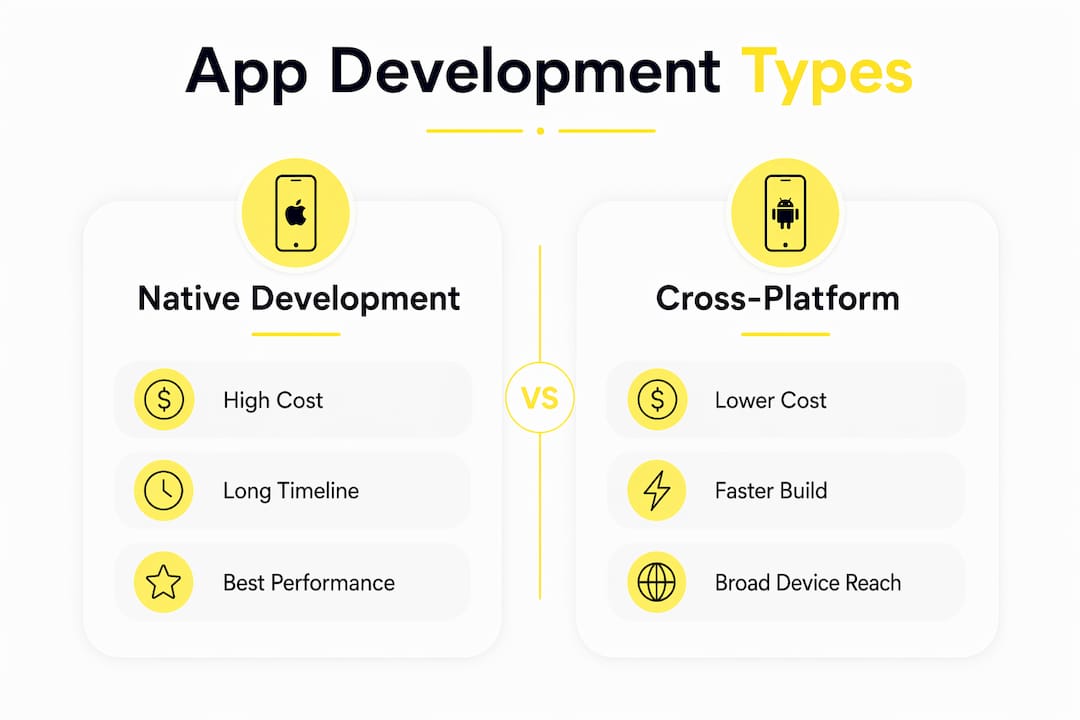
Pro Tip: Assess your required features, performance needs, and hardware integration before selecting a framework. Choosing based on trends rather than actual product needs leads to unnecessary complexity and cost overruns.
What to expect during the app development process
A well-run app build follows a clear sequence of stages. Knowing what each stage produces helps you hold your agency accountable and avoid surprises.
- Discovery and scoping. The agency maps your product requirements, user flows, and technical constraints. You should receive a scoping document and a fixed-price proposal before any code is written.
- UX/UI design. Wireframes come first, then high-fidelity designs. This stage defines how your app looks and how users move through it. Good design work at this stage prevents expensive rework later.
- Development sprints. Code is written in structured cycles, typically two-week sprints. You should have access to a staging environment to review progress in real time.
- Testing and QA. Quality assurance covers functional testing, device compatibility, performance under load, and security checks. This stage often takes longer than founders expect.
- App Store and Play Store submission. Agencies handle end-to-end submission, including developer account setup, review feedback, and compliance with store guidelines. Rejections happen and a good agency manages them without extra charges.
- Code handover and documentation. Clean code handoffs with proper documentation are non-negotiable. You need to be able to maintain or extend the app after launch, whether with the same agency or an in-house team.
An MVP typically ships in 6–8 weeks for a single platform. A full production app with both platforms runs 10–16 weeks depending on complexity. Build these timelines into your fundraising and marketing plans from day one.
Why app maintenance is not optional
Founders often treat the app launch as the finish line. It is actually the starting point of a recurring cost. Post-launch maintenance requires a monthly budget of $1,200–$4,000 to cover OS updates, security patches, crash monitoring, and performance tuning. Skipping this budget is one of the fastest ways to watch a working app become obsolete.
The risks of neglecting maintenance are concrete:
- OS updates break functionality. Apple and Google release major OS updates annually. Apps that are not updated for compatibility get flagged, demoted, or removed from stores.
- App Store policy changes require code updates. Both stores regularly update their developer guidelines. Non-compliance leads to rejection or removal.
- Security vulnerabilities accumulate. Unpatched dependencies and outdated APIs create real exposure, especially for apps handling user data or payments.
- Crash rates rise. Without active monitoring, crashes go undetected until users leave negative reviews. Cloud security best practices for startups apply directly to mobile apps handling sensitive data.
Pro Tip: Negotiate your maintenance agreement before you sign the build contract. Agencies that include maintenance in their service model are more invested in the long-term quality of the code they write.
The $1,200–$4,000 monthly range is a real budget line, not a nice-to-have. Build it into your financial model before you commission the build.
How to select and work with an app development agency
The right agency does more than write code. It helps you make better product decisions, manages the submission process, and hands over something you actually own. Here is what to evaluate before signing anything:
- IP ownership. You should own 100% of the code, designs, and assets on day one of handover. Confirm this in writing before the project starts.
- Direct engineer access. Filtered communication through a project manager slows decisions and creates misunderstandings. Ask whether you will speak directly with the engineers building your product.
- Fixed-price proposals. Time-and-materials billing creates budget uncertainty. A fixed-price proposal with defined milestones protects you from scope creep.
- Tech stack experience. Ask specifically about experience with your chosen framework, whether React Native, Flutter, Swift, or Kotlin, and ask to see relevant past work.
- Maintenance plans. An agency that offers no post-launch support is telling you something about how they view the relationship.
- Submission track record. App Store and Play Store rejections are common. Ask how the agency handles them and whether rejection management is included in the project fee.
For founders who want broader context on evaluating technology partners, IT consulting best practices for 2026 offer a useful framework for assessing agency fit and governance.
Wallandfifth works with founders directly, with senior engineers involved from scoping through launch. The LOOPA app build, delivered for £16,000, covered brand direction, wireframes, product logic, APIs, EAS, Xcode, and App Store submission from start to finish.
Key Takeaways
The most effective app development approach combines the right technology choice, a realistic maintenance budget, and a development partner who hands over code you fully own.
| Point | Details |
|---|---|
| Match tech to product needs | Choose cross-platform for most apps; reserve native for hardware-intensive use cases. |
| Plan for realistic timelines | MVPs ship in 6–8 weeks; full cross-platform production apps take 10–14 weeks. |
| Budget for maintenance | Post-launch support costs $1,200–$4,000 per month and is not optional. |
| Demand clean handover | Require full documentation and IP ownership before signing any agency contract. |
| Prioritize direct communication | Agencies with direct engineer access make faster, better decisions for your product. |
What I have learned from watching founders get this wrong
The pattern I see most often is a founder who spent three months choosing a tech stack and three weeks choosing an agency. Those priorities are backward. The agency decision is the one that determines whether your product ships on time, whether the code is maintainable, and whether you actually own what you paid for.
The second pattern is treating maintenance as optional. I have seen well-built apps become unusable within 18 months because the founder assumed the launch was the end of the investment. Apple’s annual OS releases alone require active attention. Add Google Play policy updates and security patching, and you are looking at a real ongoing workload.
The third pattern is choosing a framework because it sounds impressive in a pitch deck. Flutter and React Native are both excellent. The question is not which one sounds better. The question is which one fits your product’s actual requirements and your team’s future ability to maintain it.
The founders who get this right share one habit: they define what success looks like for the first six months before they write a single brief. That clarity makes every downstream decision faster and cheaper.
— William
Wallandfifth builds apps for founders who need more than a developer
Wallandfifth is a product design and build agency that works with ambitious founders from idea through launch. We cover product strategy, UX/UI design, custom app development, and post-launch support under one roof.
Every project comes with fixed pricing, direct engineer access, and full IP ownership on handover. We do not hand you a codebase and disappear. Recent work includes the LOOPA app, a full build covering brand, design, logic, APIs, and App Store submission for £16,000. If you are planning an MVP or a full mobile product, our product development for startups service is built for exactly this stage.
FAQ
What are app development services?
App development services are end-to-end solutions for designing, building, testing, and launching mobile or web applications. They typically cover discovery, UX/UI design, development, QA, submission, and post-launch support.
How long does it take to build an app?
An MVP on a single platform typically ships in 6–8 weeks. A cross-platform production app covering iOS and Android takes 10–14 weeks, while native builds for both platforms run 16 weeks or more.
What is the difference between native and cross-platform development?
Native development uses Swift for iOS and Kotlin for Android, offering the deepest hardware integration. Cross-platform frameworks like Flutter and React Native share one codebase across both platforms, reducing cost and time for most business and SaaS apps.
How much does app maintenance cost per month?
Post-launch maintenance typically costs $1,200–$4,000 per month, covering OS updates, security patches, crash monitoring, and App Store compliance. This is a recurring cost that should be built into your budget before the build starts.
What should I look for in an app development agency?
Prioritize full IP ownership, fixed-price proposals, direct engineer access, and a clear maintenance plan. Ask to see past App Store submissions and confirm that rejection handling is included in the project scope.
Recommended
- App Development for Founders — Custom Web & Mobile Apps, Owned by You | Wall & Fifth | Wall & Fifth
- Product Development for Startups — From Idea to Launched Product | Wall & Fifth | Wall & Fifth
- App Development Cost — What Building an App Really Costs | Wall & Fifth | Wall & Fifth
- MVP Development for Startups - Ship Before the Runway Runs Out | Wall & Fifth | Wall & Fifth