Web App Development Services: A Founder's Guide
Web App Development Services: A Founder’s Guide

Web app development services are custom software builds delivered through a browser, designed to automate business workflows, serve users at scale, and replace the manual processes that slow growing companies down. Unlike a standard website, a web application handles logic, data, user accounts, and real-time interactions. Founders who treat these two things as interchangeable almost always underbuild. The right custom web application gives you a product you own, a codebase you control, and a system built around how your business actually works.
What types of web apps can startups build with these services?
Web app types span a wide range of business functions, and the right category depends entirely on your workflow and user base. The most common builds include:
- SaaS platforms with subscription billing, multi-tenant architecture, and user management. These are the most complex to build but generate recurring revenue.
- Enterprise dashboards that pull data from multiple sources and present it in a single interface. Decision-makers use these to monitor operations without switching between tools.
- Custom CRM and ERP systems built around your specific sales or operations process, rather than forcing your team to adapt to off-the-shelf software.
- Internal portals and workflow automation tools that replace spreadsheets, email chains, and manual approval processes.
- Client and customer portals for booking, ordering, document sharing, or account management.
Each of these app categories is built to support unique workflows, scalability requirements, and operational complexity. A booking portal for a 10-person team has very different architecture needs than a SaaS platform serving thousands of concurrent users.
Pro Tip: Before you scope your build, map the exact workflow your app needs to replace or create. The clearer your process map, the more accurate your quote and the faster your build.
How does the web app development process work?
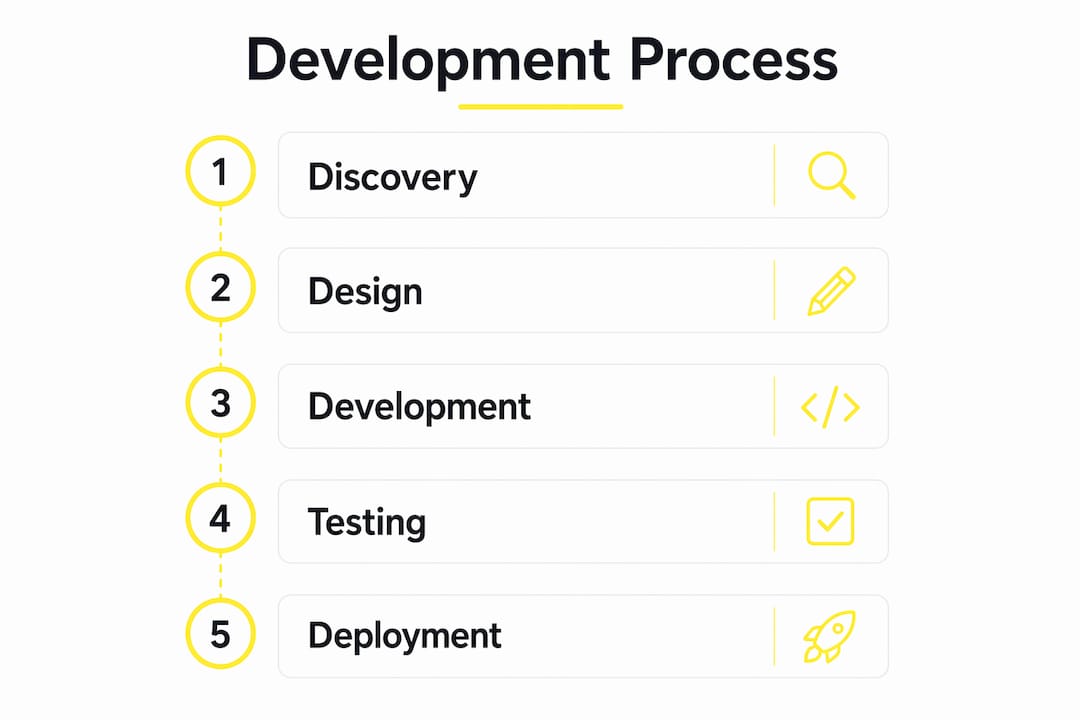
A structured development process is what separates a product that ships from one that stalls. Typical web app development follows six clear phases:
- Discovery and requirements gathering. Your development partner interviews stakeholders, maps business workflows, and defines what the system must do. This phase prevents expensive rework later.
- Planning and system design. The team defines the tech stack, database structure, API architecture, and user roles. Decisions made here affect every line of code that follows.
- UI/UX design and prototyping. Wireframes and interactive prototypes are built before any production code is written. This lets you validate the experience without paying for full development.
- Full-stack development in agile sprints. Code is written in focused cycles, with working software demos delivered every two weeks. This keeps you informed and gives you real checkpoints to redirect if needed.
- QA, security testing, and compliance. OWASP security standards, role-based access control, multi-factor authentication, and penetration testing are built into the cycle, not bolted on at the end. Regulated industries require compliance integrated from the start.
- Launch and ongoing support. Deployment, monitoring, and post-launch iteration keep the product stable as your user base grows.
Pro Tip: Ask your development partner for a demo at the end of every sprint. If they can’t show you working software every two weeks, that is a process problem worth addressing before it compounds.
The agile approach matters because it gives you visibility. You are not waiting six months to see what you paid for. You are reviewing real software at regular intervals and making informed decisions throughout.

What factors influence the cost and timeline of web app development?
Cost is the question every founder asks first, and the honest answer is that it depends on complexity. Custom web app development costs start from around $8,000–$30,000 for simple internal tools and rise to over $600,000 for complex SaaS or enterprise platforms. Mid-market projects typically land between $50,000 and $500,000 depending on scope and scale. That is a wide range, but it reflects real differences in what is being built.
| App complexity | Typical cost range | Typical timeline |
|---|---|---|
| Simple internal tool | $8,000–$30,000 | 6–10 weeks |
| Mid-complexity web app | $50,000–$150,000 | 3–5 months |
| Full SaaS or enterprise platform | $150,000–$600,000+ | 6–12 months |
The factors that push costs up include:
- Third-party integrations. Connecting your app to existing CRMs, ERPs, payment gateways, or data providers adds development time. API integrations require clean documentation and testing on both sides.
- User roles and permissions. The more complex your access control model, the more logic needs to be built and tested.
- Scalability requirements. Building for 100 users is different from building for 100,000. Infrastructure decisions made early affect both cost and performance.
- Compliance and security. Regulated industries like fintech, healthtech, or legal require additional security architecture and audit trails.
Fixed pricing is worth asking about directly. A transparent proposal with a defined scope protects both sides. Vague retainer arrangements with no clear deliverables are where budgets disappear without accountability.
Understanding enterprise B2B buying processes also helps founders who are building for business customers, since procurement timelines and compliance requirements often shape what the product needs to do before it can be sold.
How do you choose the right web app development service provider?
The best development partners act as technical consultants, not just code vendors. Vendors who contribute to strategic planning before writing a single line of code produce better long-term outcomes. They help you refine business logic, API strategy, and scalability decisions upfront. That input is worth more than a fast quote.
When evaluating providers, focus on these criteria:
- Relevant experience. Have they built apps in your category before? A team that has shipped a SaaS platform understands multi-tenancy, billing logic, and user management in ways a generalist shop may not.
- Security and compliance knowledge. Ask specifically how they handle OWASP standards, auth, and data protection. If they cannot answer clearly, that is a red flag.
- Ownership and IP rights. Full source code ownership means you can self-host, modify, or hand the codebase to another team without permission or additional fees. Confirm this in writing before signing.
- Ongoing support model. What happens after launch? A provider with no post-launch support plan leaves you exposed when bugs surface or traffic spikes.
- Contract terms and vendor lock-in. Review whether your hosting, infrastructure, or third-party licenses are tied to the vendor. Lock-in is a recurring cost that compounds over time.
Pro Tip: Request a sample contract before you commit. The ownership clause and post-launch support terms tell you more about a vendor’s intentions than any sales conversation.
The right partner makes the product better before the build starts. They push back on features that add complexity without adding value, and they flag technical risks before they become expensive problems.
Key Takeaways
Custom web app development services require clear scope, a structured process, and a partner who owns the strategy alongside the code.
| Point | Details |
|---|---|
| Define your app category first | SaaS, internal tool, or client portal each require different architecture and budget expectations. |
| Agile delivery reduces risk | Biweekly demos give you real checkpoints to redirect before costs compound. |
| Cost scales with complexity | Simple tools start around $8,000; full SaaS platforms can exceed $600,000. |
| Ownership must be contractual | Confirm full source code and IP ownership in writing before any work begins. |
| Choose a consultant, not just a coder | Vendors who shape strategy before coding produce better and more durable products. |
What I have learned from watching founders commission web apps
The founders who get the most from their development partners are the ones who treat the relationship as a technical co-founder arrangement, not a vendor transaction. They share business context, revenue models, and user research. They ask hard questions about architecture. They push back when a feature feels like scope creep.
The founders who struggle are the ones who hand over a brief and wait. They get exactly what they asked for, which is rarely what they needed. A good development partner will tell you when your idea has a logic problem, when your database design will not scale, or when a simpler approach would ship faster and cost less. That kind of input only happens when you create the conditions for it.
Investing in UI/UX design before development is the single most underrated decision in a web app build. Founders who skip wireframes to save money almost always pay more in rework. A prototype costs a fraction of a rebuild. The same applies to security. Bolting on OWASP compliance after launch is significantly more expensive than building it in from the start.
Agile delivery is not just a process preference. It is a transparency mechanism. If your partner cannot show you working software every two weeks, you have no real visibility into what you are funding. Demand it as a baseline, not a premium.
— William
Wallandfifth builds web apps that founders actually own
Wallandfifth works with founders and businesses who need more than a developer. We shape what should be built, design how it should work, and push it through to a launched product you own outright.
Our web app development service covers the full build: discovery, product logic, UI/UX design, full-stack development, and launch. Every client owns their source code with no ongoing dependency on us post-launch. For founders validating an idea, our MVP product design service puts commercial logic before visual craft, so you ship something that works and converts. If you are ready to build, we are ready to scope it.
FAQ
What is the difference between a web app and a website?
A website delivers static or semi-static content to visitors. A web application handles user accounts, business logic, data processing, and real-time interactions through a browser.
How long does it take to build a custom web application?
Project timelines range from 6–10 weeks for simple tools, 3–5 months for mid-complexity builds, and 6–12 months for full SaaS or enterprise platforms.
What is a progressive web app?
A progressive web app is a browser-based application built with web technologies that behaves like a native mobile app, including offline access, push notifications, and home screen installation, without requiring an App Store download.
Do I own the code after the project is complete?
Full source code ownership means you can self-host, modify, or transfer the codebase without permission or additional fees. Confirm this in your contract before work begins.
What is the minimum budget for a web app build?
Simple internal tools start around $8,000–$30,000. Mid-market custom web applications typically require $50,000–$150,000 depending on features, integrations, and scalability requirements.
Recommended
- How to Choose a Web App Development Company in 2026 | Wall & Fifth
- App Development for Founders — Custom Web & Mobile Apps, Owned by You | Wall & Fifth | Wall & Fifth
- Blog — Digital Strategy for Founders & Operators | Wall & Fifth
- Web App Development — Custom Web Applications, Owned by You | Wall & Fifth | Wall & Fifth