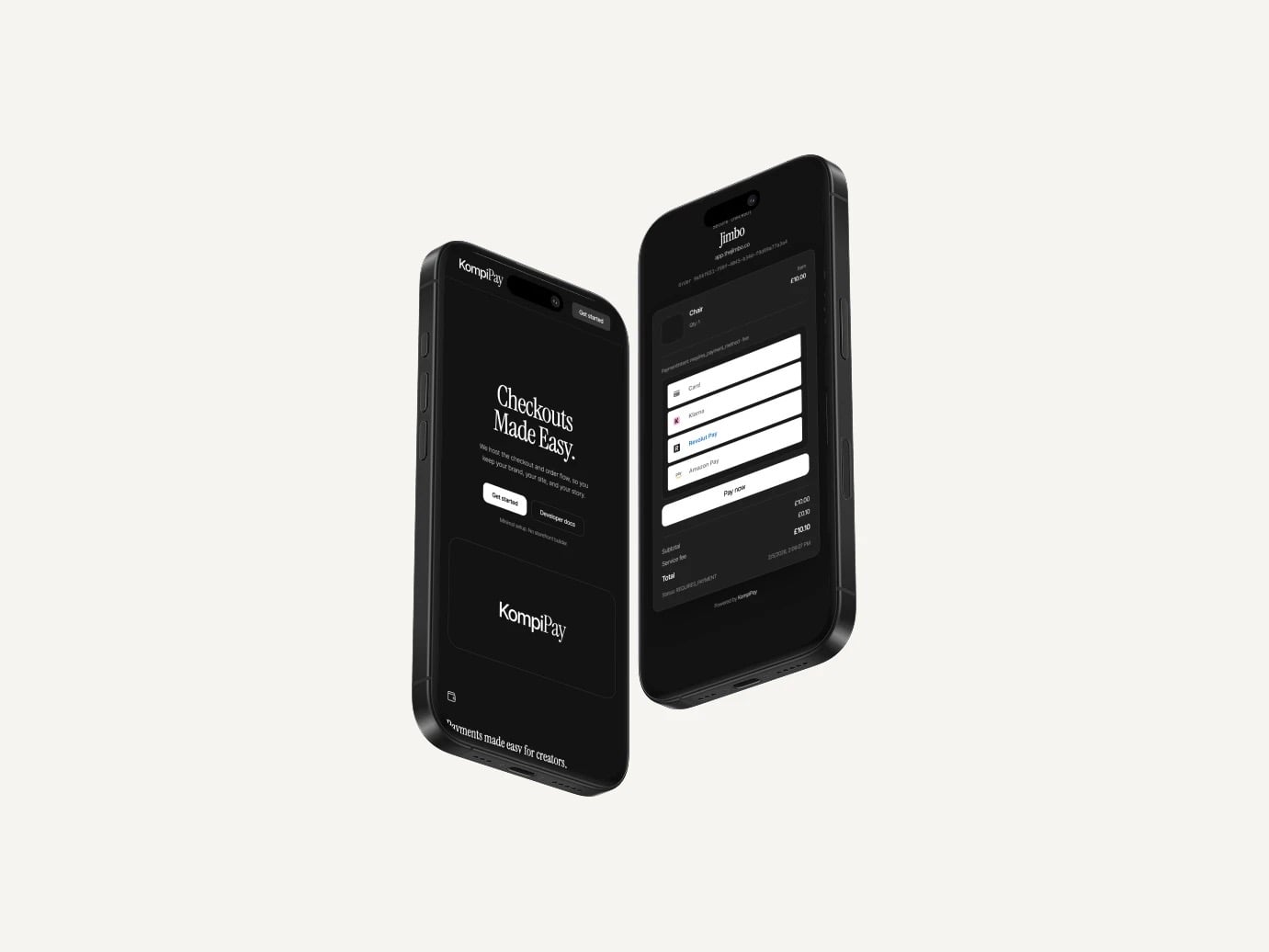
We design and build payment products on Stripe: onboarding, checkout, payouts and subscriptions, designed so nobody is ever unsure where their money is.
Stripe handles the hard regulated parts: processing, card data and identity checks. Whether people start, finish and come back is decided by everything built around it. That's the part we design and build.
01Create your payment pageFirst02Preview it and share the linkFirst03Verify your identityThen04Add payout detailsThen
A working payment page before anything sensitive
Illustration · the onboarding order on KompiPay
Get people to something real first.
Verification, bank details and compliance steps usually arrive first, and they feel like risk rather than progress. On KompiPay we sequenced onboarding so people reach a working payment page they can share before they're asked for anything sensitive. The checks still happen, once there's a reason to finish them.
PendingThe customer's bank is confirming it.Nothing to do yet
SucceededPaid. It arrives with your next payout.View receipt
FailedDeclined. No money was taken.Send a new link
RefundedReturned to the customer's card.View refund
DisputedThe customer has queried it with their bank.Add evidence
Illustration · payment states, each with a plain explanation and a next action
Never leave money ambiguous.
Pending, succeeded, failed, refunded and disputed all need to be visible, explained and recoverable. Underneath, Stripe's events are the record of what happened, every payment action is safe to retry so a dropped connection never charges twice, and the product reconciles what it shows with what Stripe reports.
Restraint, clear hierarchy and precise typography do more for conversion in a financial product than any persuasion pattern. KompiPay's visual system was built to read as credible infrastructure rather than a consumer app, with no surprise fees, no unexplained holds and no dead ends when something fails.
Most payment products use one or more of four building blocks. The right mix depends on who pays, who gets paid and how often.
Stripe Checkout.
A payment page hosted by Stripe. Quick to launch, well optimised and handles cards, wallets and local methods. Often the right first step for selling a product or taking a deposit.
Fastest to launch
Stripe-hosted, so card data never touches you
Cards, wallets and local methods
Best for straightforward payments
KompiPay / checkout
Payment inside your journey.
Stripe's embedded payment components sit inside your own page. Worth it when payment is one step in a longer journey, like a booking, a quote or a multi-step order, and a redirect would break the flow.
Payment as part of the journey
Your design, Stripe's secure fields
Bookings, quotes and orders
Best when a redirect would cost conversions
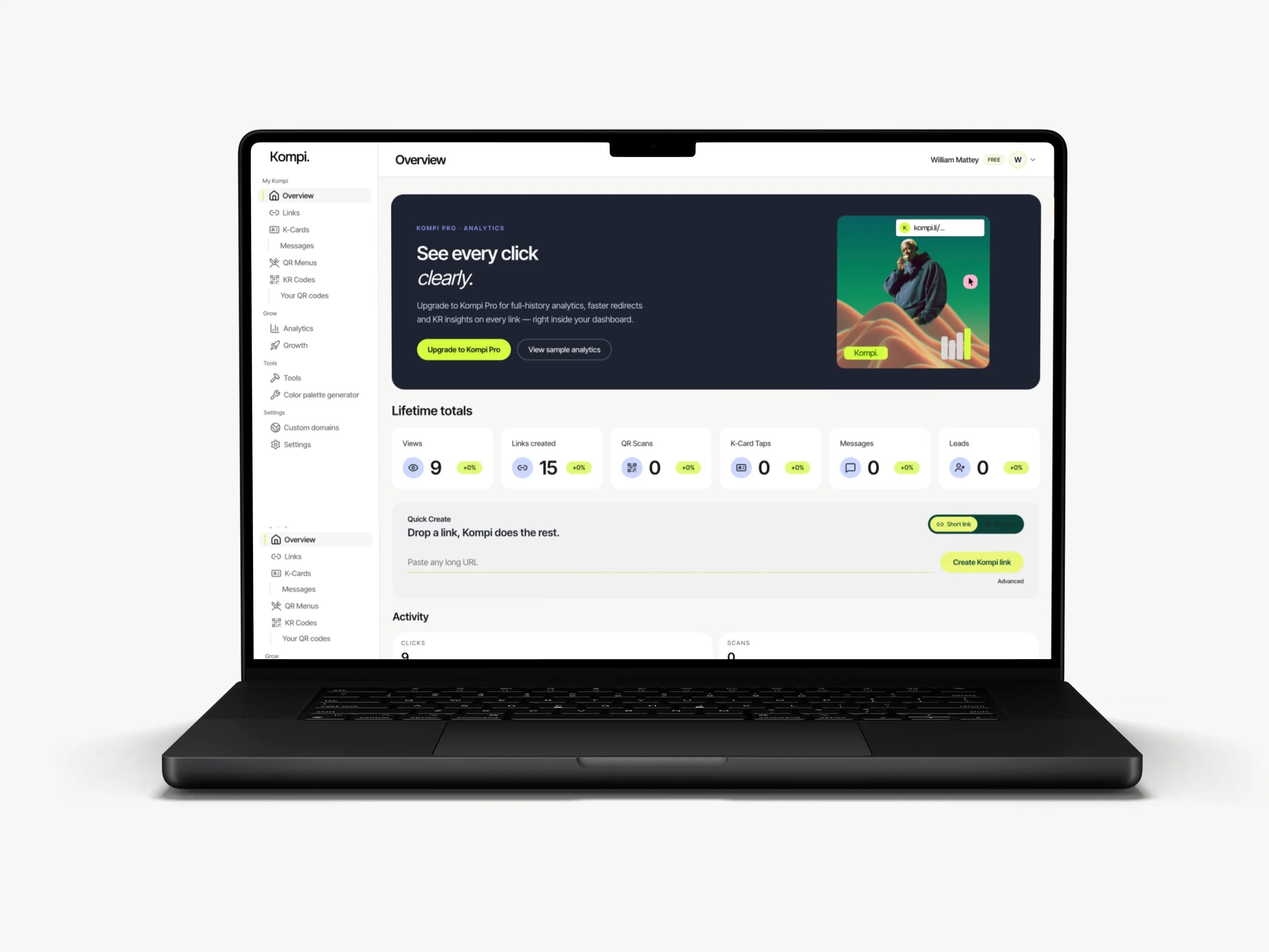
Kompi.App / commerce as a block
Marketplaces and platforms.
Stripe Connect lets a platform take payments on behalf of other people, keep a fee and pay out the rest. Sellers onboard and verify through Stripe; you design how everyone sees what they're owed.
Seller onboarding and verification
Platform fees taken automatically
Payouts to sellers
Best for marketplaces and multi-party payments
Customer pays£100Through your checkout
→
Platform keeps£10Your fee, taken automatically
→
Seller receives£90Paid out by Stripe
Illustrative split
Subscriptions and plans.
Stripe Billing runs recurring payments: plans, trials, upgrades, invoices and failed-payment recovery. The product work is in plan design, upgrade moments and making changes to a subscription feel safe.
Plans, trials and upgrades
Invoices and receipts
Failed-payment recovery
Best for SaaS and memberships
Kompi.App / upgrade moment
From our portfolio
Money moving. People staying.
Our own payments products, and client work where fees, commission and balances had to be clear to everyone.
A focused payment product: onboarding, one payment flow, clear payment states and an operator dashboard.
Full product
Quoted
Marketplace payouts, subscriptions, multiple payment flows, finance reporting and integrations, scoped to your model.
Embedded Partner
From£8,000/month
Ongoing senior involvement once it's live: new payment features, conversion and the roadmap.
You own your data and the custom deliverables agreed in your contract. Reusable components and third-party software retain their licences. The proposal specifies any retained IP, licensing, hosting and exit terms before work starts.
Do I need my own payment licence to build a payment app?
For most products built on Stripe, no: Stripe processes the payments and handles card data, and its onboarding covers identity checks for the people you pay out to. Some models, such as holding customer money, lending or currency exchange, can bring their own regulatory requirements. We flag those early, and you should take specialist legal advice on them.
Should we use Stripe Checkout or a custom payment flow?
Stripe Checkout is quick to launch and well optimised, and it's often the right first step. A custom flow built with Stripe's embedded payment components makes sense when payment is part of a longer journey, like a booking, a quote or a multi-step order, and a redirect would break it. Either way, card details are collected by Stripe's own fields, not your servers.
How do marketplaces take a cut and pay sellers?
Through Stripe Connect. Sellers onboard through Stripe, customers pay through your platform, your fee is taken automatically and the rest is paid out to the seller. The product work is in onboarding sellers smoothly, showing everyone where their money is, and handling refunds and disputes fairly between the parties.
What makes a payments product feel trustworthy?
Clarity about money at every step. Each payment state (pending, succeeded, failed, refunded, disputed) needs a plain explanation and a next action, because ambiguity in a money product reads as loss. Restrained, precise design also does more for trust than persuasion. Both were central to how we built KompiPay.
How much does it cost to build a payment app?
New product builds start from £30,000. Larger payment products are quoted individually according to the payment model, onboarding, payouts, subscriptions, integrations and administration required. We agree the fixed price, scope and delivery schedule before work starts.
Have you built a payments product?
Yes. KompiPay is a Wall & Fifth-owned payments product built on Stripe. It lets creators and small businesses create a payment link in minutes and accept payments without a storefront or a developer. We designed and built its onboarding, payment creation, checkout and dashboard. We've also built commission, fee and balance tracking into custom CRMs, such as BNOC's.